
The use of Artificial Intelligence (AI) is increasingly present in everyday life and is gaining more space in people's lives. In Medicine, AI is an expanding field, with a growing number of studies and applications available to promote better health and quality of life for the population.
But to what extent is it possible to use Artificial Intelligence in Medicine without exceeding the ethical boundaries of the profession?
In this article, you will gain a better understanding of the practical applications of Artificial Intelligence in Medicine and the ethical limits of its use.
What is Artificial Intelligence in Medicine?
Artificial Intelligence is a field of computing focused on developing systems capable of automatically performing tasks that would normally require human intervention. In medicine, according to the Federal Council of Medicine (CFM), AI can assist in diagnoses, personalize treatments, predict clinical outcomes, and optimize administrative processes.
Unlike traditional software, AI learns continuously from the information provided, becoming increasingly accurate and efficient. This is because Artificial Intelligence uses technologies such as machine learning and deep learning to interpret exams, predict risks, and even support patient care.
Contrary to the idea that Artificial Intelligence is emerging to replace human work, in Medicine it acts as a complement to medical practice.
It offers rapid analyses that help reduce errors and increase patient safety. The big question is that, with its increasing incorporation, the role of healthcare professionals will eventually be redefined and will require a greater understanding and mastery of these technologies.
Practical Applications of Artificial Intelligence in Medicine
Today, the use of Artificial Intelligence in Medicine is already a reality. According to a study published by the Brazilian Journal of Implantology and Health Science, AI has stood out precisely for its ability to accelerate processes, support clinical decisions, and increase patient safety.
Among the most relevant applications, the following can be highlighted:
Diagnosis
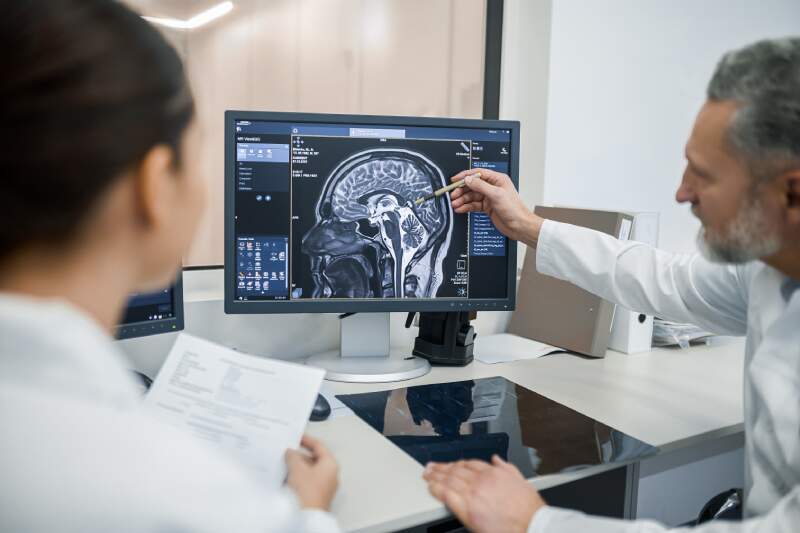
Artificial intelligence can assist in identifying clinical patterns that are not always immediately apparent, thus aiding in the early detection of changes and diseases. This capacity for rapid and accurate processing should reinforce medical work, acting as a complementary tool to the professional's clinical observation.
Outcome prediction and risk assessment
AI models can predict clinical behaviors and likely outcomes based on the patient's condition and individual characteristics. In this way, they allow physicians to anticipate potential complications and plan more appropriate interventions for each case.
Optimizing processes in healthcare
The study also highlights that AI has the potential to organize workflows, automate operational steps, and improve the efficiency of healthcare services. This reduces rework, speeds up care, and contributes to a more structured clinical environment.
Support for decision-making
Artificial intelligence can also be used as a tool to support clinical reasoning. Some models are already capable of cross-referencing information and presenting suggestions that assist the physician in decision-making.
According to Veja magazine, this technology can already be seen in triage services in emergency rooms, in the detection of abnormalities in tests, and in the monitoring of patients in ICUs, for example. Furthermore, outside the hospital environment, Artificial Intelligence can also be used for daily health monitoring through apps and devices such as smartwatches.
Ethical limits and challenges of using AI in medicine
Despite the rapid advancement of Artificial Intelligence in healthcare, the use of these technologies still raises important questions about safety, transparency, and professional responsibility. Currently, there is no official resolution from the CFM (Brazilian Federal Council of Medicine) regarding the use of Artificial Intelligence in medical practice. However, in a statement, the body affirms that it is making progress in drafting a future resolution that will establish guidelines for the development, use, and governance of Artificial Intelligence-based solutions in medicine.
The statement reinforces the Council's commitment to ensuring the safe use of these tools for healthcare professionals and patients.
It also affirms that the Council upholds fundamental medical values such as medical autonomy, the protection of sensitive data, and, above all, professional confidentiality.
Other ethical challenges also deserve attention. Professionals must consider issues such as the transparency of algorithms and the risk of compromising equity in care. Furthermore, it is important to define responsibilities in case of error. In the current scenario, with the constant evolution of technologies and increasingly more spaces for their application, the big question is finding a balance to leverage the potential of Artificial Intelligence in Medicine. At the same time, it is fundamental to guarantee an ethical, safe, and human-centered medical practice.
The Future of Artificial Intelligence in Medicine
According to Charles Souleyman, CEO of the Total Care Network, the question is no longer whether Artificial Intelligence will be used in medicine , but when and how it will be used. For this to happen, it is crucial that the training of doctors and other healthcare professionals in the use of this technology becomes a reality. According to the expert, it is essential that doctors are prepared to formulate the right questions for Artificial Intelligence, which requires prior preparation.
Thus, more than mastering tools, the great challenge lies in developing a medical practice that unites Artificial Intelligence and clinical sensitivity. In this way, the combination of both represents an opportunity to transform healthcare and pave the way for increasingly precise and efficient medicine. At the same time, it preserves the essential qualities of human treatment.